
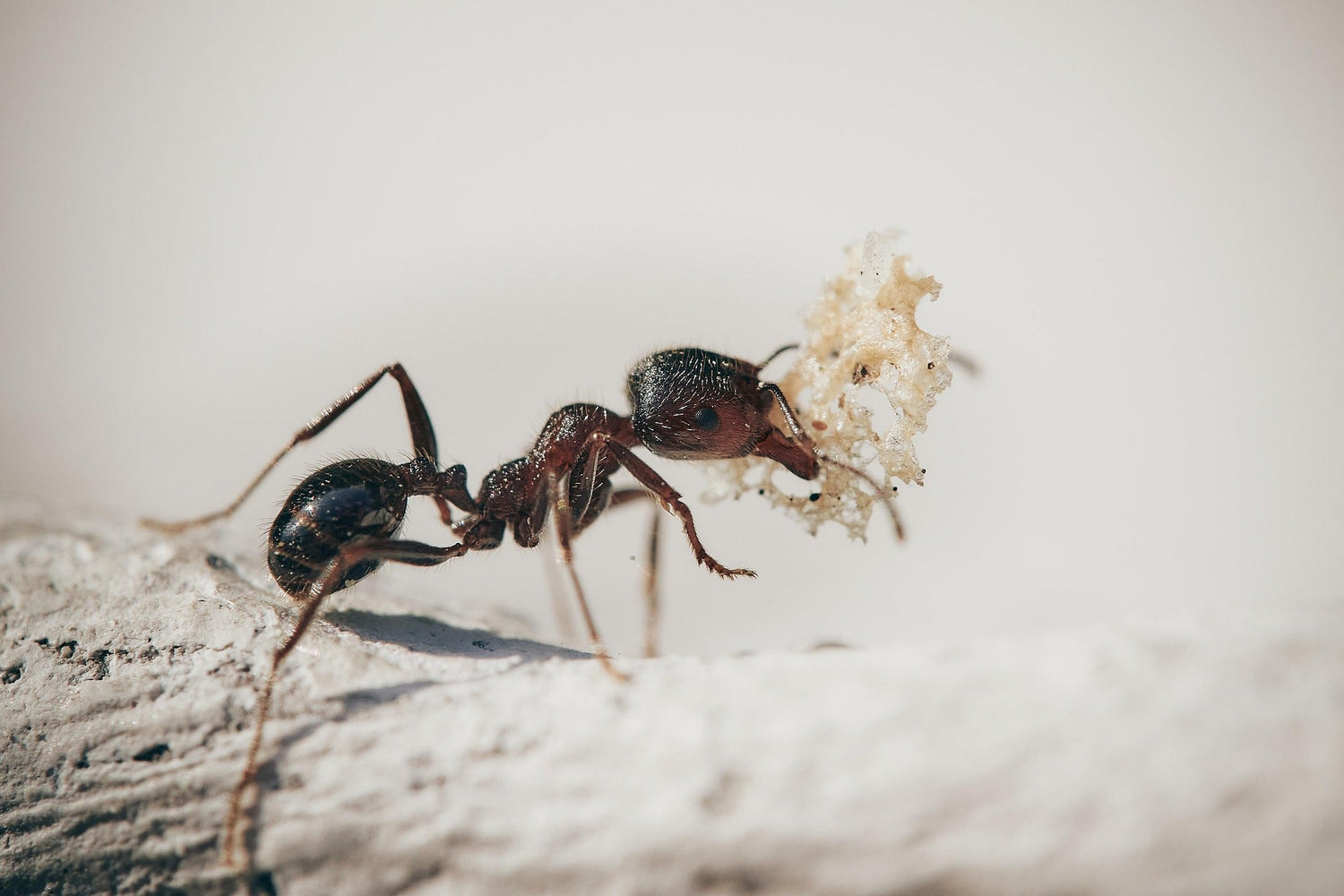
Carpenter ants in the house are one of the more serious ant problems you can encounter. Unlike common garden ants that seek their way inside in search of food, carpenter ants actually build their nest inside the wooden structure — and prefer to do so in floor joists, the house foundation, or behind damp walls.
The good news: carpenter ants do not eat wood. The bad news: they gnaw tunnels through it, and an established nest can over time cause structural damage that becomes more costly to address the longer it is allowed to grow. If you know what to look for, it is possible to catch the problem early.
What are carpenter ants?
Carpenter ant is a collective name for ants of the genus Camponotus. In Sweden, Camponotus herculeanus is the most common species. It is a large, black ant — the worker ants are 6–14 mm long, and the queen can reach up to 18 mm. It is therefore easy to distinguish them from common garden ants, which are half the size.
Carpenter ants live in colonies of thousands of individuals. A mature colony can have existed in the same wooden structure for 10–15 years without being properly noticed — which is the reason why the damage can sometimes become serious before it is detected.
How do you recognize carpenter ants in the house?
The clearest sign is piles of sawdust — small mounds of wood fiber, soil particles, and dead insects that collect outside the ants' entry holes. It looks like coarse sawdust or grains of sand and often ends up near doors, window frames, baseboards, or at the foundation.
Other signs to watch out for:
- Large, black ants indoors — especially late in the evening or early in the morning
- Crackling or rustling sounds from walls or floors, particularly in a quiet cottage at night
- Visible entry holes in wood — round or oval, approximately 3–6 mm in diameter
- Ants crawling along pipes, cables, or beams in the basement
What damage do carpenter ants cause?
Carpenter ants gnaw out tunnels and chambers inside the wood to create a nesting space. They prefer soft, moist wood — and that is an important keyword. Carpenter ants typically seek out wood that is already affected by moisture or rot. This means that a carpenter ant problem is often a symptom of an underlying moisture problem.
Common locations for carpenter ant nests in the house:
- Crawl space and house foundation — damp, dark, and undisturbed
- Floor joists near bathrooms, kitchens, or laundry rooms — surfaces frequently exposed to moisture
- Wooden window and door frames — old seals or moisture intrusion
- Roof beams and attic spaces — moisture from poor ventilation or a leaking roof
- Logs and log walls in older houses and cottages
A small colony causes limited damage. But if a nest has been present for 5–10 years, the tunnels can have spread considerably through the structure, which in the worst case affects load-bearing components. Carpenter ants also contribute to accelerating the existing rotting process.
Carpenter ants or termites — important differences
It is common for people to worry about termites when they see piles of sawdust, but in Sweden termites are very rare and are virtually never found in ordinary homes. Carpenter ants are a considerably more common find.
Three simple differences:
- Carpenter ants are black and active — you often see them. Termites are pale and avoid light, you rarely see them directly.
- Carpenter ants leave piles of sawdust outside the tunnels. Termites keep the tunnels sealed and hide their traces.
- Carpenter ants do not eat the wood — they excavate it. Termites eat the wood and can essentially hollow out a floor joist from the inside.
If you are unsure you should still contact a pest control professional for an assessment, but in most Swedish homes it is a matter of carpenter ants.
Why do carpenter ants seek out your house in particular?
Common reasons why carpenter ants establish themselves:
- Moisture damage in the crawl space — poor ventilation or standing water
- Wood that is in direct contact with the ground or concrete without a moisture barrier
- Leaking pipes or poor sealing around windows and doors
- Old wood on the house foundation, deck, or fence that is rotting
- Woodpiles against the house wall — a classic entry point
What you can do — step by step
Here's the translation:
1. Locate the nest
Follow the ants' movement patterns, preferably late in the evening. They always move to and from the nest. Piles of sawdust are found near the entry holes. Also listen for crackling sounds — press your ear against the beam and tap lightly, a hollow sound can reveal tunnels.
2. Address the moisture problem
This is the most important step — and the one that determines whether the problem comes back. Identify the source of moisture and address it: seal leaks, improve ventilation in the crawl space, install a dehumidifier or insulation, remove direct contact between wood and ground.
3. Combat the colony
Insecticide gel or bait placed at the entry holes is effective against established colonies. Carpenter ants are more cautious than common ants and may take longer to be drawn to the bait. Direct treatment with insecticide dust inside the holes is used by pest control professionals and provides a rapid effect.
4. Seal the entry holes
Once the colony is gone, seal all visible holes and cracks with acrylic filler or wood filler. This prevents new colonies from establishing themselves in the same space.
When do you need professional help?
You should contact a pest control professional if:
- You find piles of sawdust in multiple places in the house — this may indicate more than one entry point or a large nest
- The tunnels are in load-bearing structures — beams, roof trusses, or foundation walls
- You cannot locate the nest despite searching
- You have tried baits for 4–6 weeks without results
An experienced pest control professional can use a thermal camera and moisture meter to locate the nest and assess the extent of the damage. It is money well spent if the alternative is missing a large nest in the floor joists.
Prevent future carpenter ant problems
The best protective measure is to keep the moisture level low in the house foundation and structure. Check the crawl space every year, make sure water does not collect against the house foundation, and avoid stacking firewood directly against the exterior wall.
Also make sure that wood is never in direct contact with the ground without a moisture barrier, and seal cracks in the foundation wall regularly.
Summary
Carpenter ants in the house are a more serious problem than common ants indoors, but it is entirely possible to manage if you act in time. Look for piles of sawdust near doors, window frames, and in the crawl space. Locate the nest, address the moisture problem, and treat with baits or insecticide. If the damage is to load-bearing structures — seek professional help.
And remember: the presence of carpenter ants is almost always a sign that there is moisture somewhere. Solve the moisture problem and you remove the most important reason for them wanting to stay.


