
Ultrasound devices designed to scare away rats and mice have become increasingly common on the market — but do they actually work in practice? It's a question many homeowners and property owners wonder about. Here we clarify what the research says and what Swedish studies from the Swedish University of Agricultural Sciences (SLU) show.
What is ultrasound and how is it supposed to work?
Ultrasound is sound with a frequency above 20,000 Hz – meaning sound that humans cannot hear. Rats and mice, on the other hand, have a considerably broader hearing range and perceive high frequencies very clearly.
In nature, rodents themselves use high-frequency sounds to communicate – for example as warnings, during stress, or in the presence of danger. The theory behind ultrasound-based deterrents is therefore straightforward: if animals are exposed to unpleasant or disruptive sounds within their most sensitive frequency range, they should experience the environment as unsafe and leave the area.
How does a rat and mouse repellent work in practice?
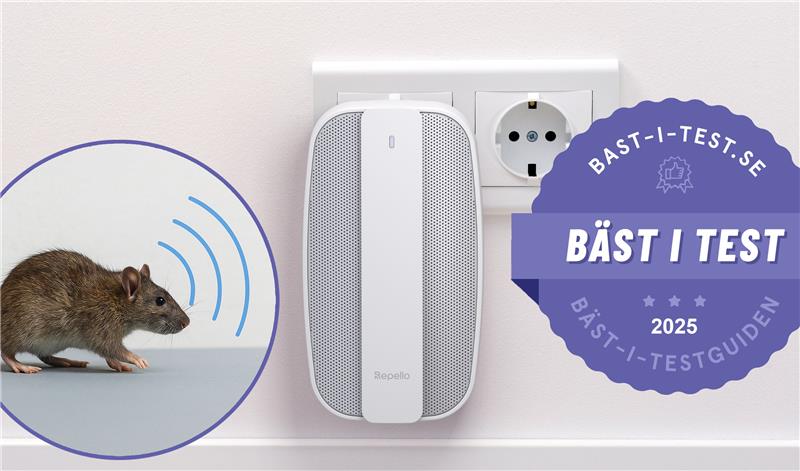
Ultrasound repellents against rats and mice are often marketed as a simple solution: plug it in, and the problem disappears. But what is actually happening when you insert such a device into a wall socket?
In practice, it is a small sound transmitter. Inside sits an electronic component that generates a high-frequency signal and a special type of speaker – most commonly what is known as a piezo element – which converts the signal into ultrasound.
When the repellent starts up, electrical pulses are sent to the speaker, which begins to vibrate extremely rapidly – tens of thousands of times per second. It is these vibrations that create pressure waves in the air. For humans the sound is inaudible, but rats and mice can perceive it because their hearing is adapted for considerably higher frequencies than ours.
Ultrasound spreads like a flashlight beam – not like "ordinary sound"
An important detail is how ultrasound moves through a home. Unlike music or voices, ultrasound does not spread effectively around corners and through materials. Instead, it behaves more like light from a flashlight:
- It travels primarily in a straight line
- It is blocked by walls and doors
- Furniture, cardboard boxes, and textiles dampen the effect
- The sound loses strength rapidly with distance
This means that placement can be crucial. A rat repellent placed behind a sofa or in a fully stocked storage room can in practice "fire" the ultrasound straight into obstacles – leaving large parts of the room without a sufficient level of coverage.
What does previous research say about ultrasound against rodents?
The accumulated research from the 1970s and onwards shows a relatively clear tendency: ultrasound can affect rats and mice initially – but the effect is often limited in duration or scope. Several studies have examined both laboratory environments and real buildings.
Laboratory tests: 30–50% reduction – then no effect
During the 1990s, Stephen A. Shumake at the Denver Wildlife Research Center conducted a series of controlled tests of commercial ultrasound devices. Rats were exposed to generic ultrasound signals in an experimental environment where researchers carefully measured movement activity, foraging behavior, and how frequently the animals passed through certain zones.
The animals were exposed to generic ultrasound signals above 20 kHz, and researchers measured movement activity and avoidance behavior.
The results showed:
- An initial reduction in movement activity of approximately 30–50%
- No statistically significant deterrent effect after 3 days
- Clear habituation (acclimatization) when the signal was monotone
The rats thus returned to normal movement patterns despite the sound still being active.
Field and laboratory tests on 11 rat repellent units
Similar results were found at The Danish Pest Infestation Laboratory, where 11 different ultrasonic devices were tested — including models that varied frequency and random intervals to reduce the risk of habituation.
The tests consisted of both laboratory setups and controlled field-like environments. Rats were placed in test spaces where they had access to food and movement zones. The ultrasonic devices were installed according to the manufacturers' instructions.
The results were even more clear:
- Initial deterrence lasted between 30 minutes and 3 hours
- No lasting reduction in population or movement patterns
- Rapid return to normal activity
Despite technical variations between the products, the conclusion was that generic ultrasonic signals did not produce long-term effects in practical environments.
SLU and Villaägarna: A Clear Scientific Conclusion
This body of research also made an impact in Sweden. When the question of ultrasound became widely debated, the Swedish Villa Owners' Association (Villaägarna) chose to ask Bo Algers, professor (emeritus) at the Swedish University of Agricultural Sciences (SLU), to summarize the state of scientific knowledge.
Algers reviewed the international literature — including the American and Danish studies — and noted that controlled experiments had shown:
- Marginal repellent effects of approximately 30–50%
- Rapid habituation
- An absence of documented long-term effects
His conclusion was clear and has frequently been cited in the debate:
"The scientific literature provides no support for the assumption that ultrasonic devices would be effective over time."
It is precisely this historical background that has led ultrasound to be regarded for many years as ineffective — or colloquially as a scam. Not because it never produced any effect at all. But because the effect was too short, too weak, and too uncertain to solve a real problem.
Ultrasound That Actually Works?
It is against this background — 40 years of short-lived and limited results — that the SLU study on Repello should be understood.
Instead of using generic, monotone ultrasonic tones, the technology is built on research into sound quality and noise disturbance. The starting point has not been to create a "disruptive" ultrasound, but to analyze how rats themselves communicate danger.

When brown rats perceive an acute threat, they can produce a teeth-grinding-related warning sound in the ultrasonic register. This is a signal that other rats interpret instinctively. It is linked to the animal's limbic system — the brain's center for fear and survival.
Repello's signal has therefore been designed to mimic this type of warning sound.
To determine whether the signal worked in practice, it was not tested in a laboratory, but in a real residential environment with documented problems with wild brown rats.
The study was conducted in an apartment building where three different spaces were monitored: a room, a corridor, and a storage room. Using infrared cameras, the rats' activity was recorded over time — first before Repello's signal was activated, and then during a three-week period with the ultrasonic signal running.

During the intervention period, the number of recorded rat observations decreased by over 90 percent compared to the period before.
But the most remarkable finding was the behavior of the rats that did appear on camera: when exposed to the sound environment, they turned around and fled immediately. In practice, this amounted to a 100 percent repellent effect upon direct exposure in the monitored areas.
This means the study demonstrated two things simultaneously:
- a clear frightening effect in the moment (rats flee immediately)
- a lasting effect over three weeks (sharply reduced activity)
Comparison: Why the SLU Study on Repello Stands Out
To understand why the results have attracted attention, it is enough to place the SLU study side by side with the most cited tests from the 1990s. The difference then becomes clear — both in environment, signal type, and above all in duration and habituation.
| Factors | Shumake 1995/1997) | Danish Pest Infestation Laboratory (11 units) | SLU-study about Repello (Örjan Johansson) |
| Test environment | Controlled tests (experimental environment) | Controlled tests (experimental environment) | Real residential environment (field) |
| Population | Rats in a controlled setup | Rats in a controlled setup | Wild brown rat population |
| Effect size | Approx. 30–50% reduction in movement activity | Initial repellent effect, but without lasting measurable effect | 100% repellent effect, 91% fewer observations |
| Duration | No significant effect after 3 days | Approx. 30 min – 3 hours | 3 weeks |
| Habituation | Rapid habituation | Rapid habituation | No signs of habituation |
| Signal type | Generic/monotone ultrasonic signals | Generic/monotone ultrasonic signals | Bioacoustic, pulsed warning signal (25–85 kHz) |
It is precisely the combination of a qualitatively designed warning signal, tested in a real residential environment with a measurable effect over several weeks, that causes the SLU result to break with the historical research picture — where ultrasound most often produced a brief reaction, and then lost its effect as the animals habituated.