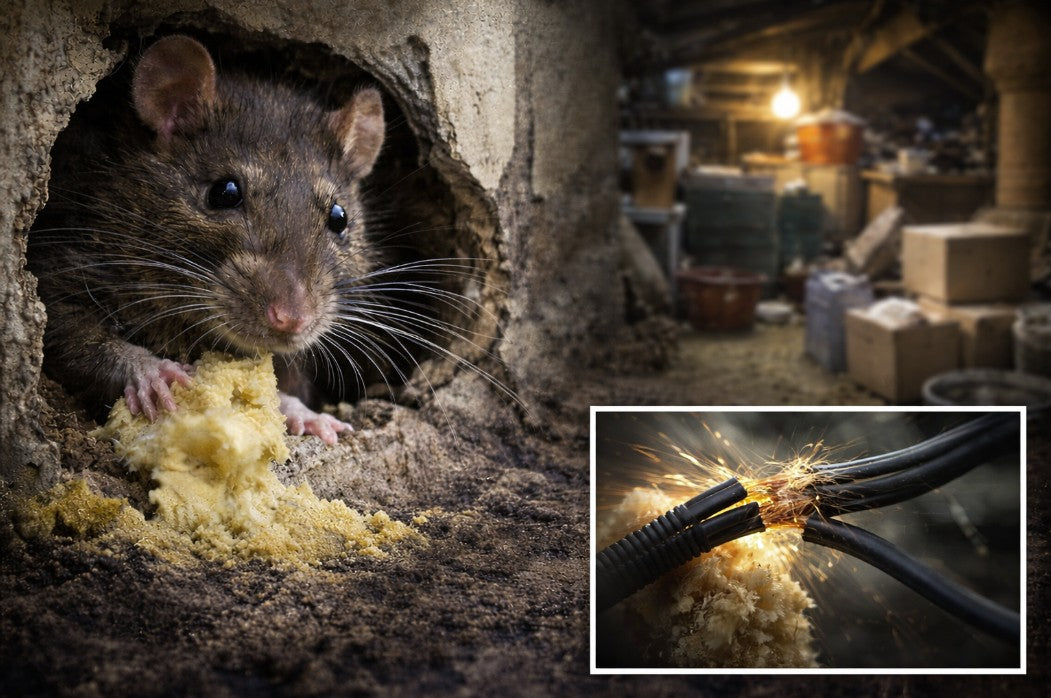

Many people make the same mistake — and pay the price. Tests at the Swedish University of Agricultural Sciences point to a completely different approach that is turning heads.
It often starts in desperation.
You hear a rustling in the wall. A gnawing in the ceiling. You find droppings in the storage room and feel your stomach drop. And like so many others, you do what feels most logical: you go out and buy a rat repeller. One that promises to keep rats away with "ultrasound" that humans can't hear.
You plug it in, it lights up, occasionally beeps — and at first it almost feels like you've done something meaningful. You get a sense of control.
But then the days pass. And the sound in the wall comes back.
This is where many homeowners say it gets especially unsettling: you realize the problem isn't just going to "disappear" — and that what you thought was a solution perhaps wasn't one at all.
The mistake many people make — and why rats don't care
There's a reason so many people are disappointed by cheap rat repellers.
Because rats are not stupid. They are adaptable, quick learners and fast to get used to sounds that don't mean anything. And that's exactly where the problem lies with many ordinary repellers. They make noise. But they don't say anything that rats actually interpret as danger.
For a rat, an "annoying sound" is not the same thing as a life-threatening situation. If a sound doesn't represent a real threat, the rat won't flee. Instead it will do something else entirely:
It adapts. They hide deeper inside. They change route. They wait it out. And when they realize the sound has no consequences, they stop caring.
That's when the rats win.
👉 Why ordinary rat repellers stop working — read more here!
"They adapt. That's why it so often doesn't work."

When we speak with Örjan Johansson, professor at Luleå University of Technology, he says this is the key difference between "a repeller that makes noise" and a method that actually influences behavior.
"Rats are extremely good at adapting. If a sound is merely irritating but doesn't signal danger, they get used to it. That's why many people find that ordinary repellers work at first and then not at all," says Örjan.
And this is also why many homeowners end up in a vicious cycle.
You buy a cheap repeller. You get a brief reprieve. Then the sounds come back — and sometimes it feels almost worse, because you thought you had already solved the problem.
The real problem is this: you can't see them
Another thing that makes rats so difficult to deal with is that they almost never show themselves at first.
They work in the shadows. In the insulation. Under the floor. Behind the walls. In the attic. In the crawl space. This means you can have rats in your house without knowing it. You only hear fragments: a rustle, a movement, a gnaw.
And by the time you see clear signs — droppings, gnaw marks, torn insulation — they have often already built tunnels and nests. That's when many people realize this isn't about "one rat."
It's about an entire operation.
👉 Do you hear sounds in the walls? See what actually works
"All it takes is one small opening"
Örjan also points out that many homeowners overestimate how "sealed" their houses really are.
"Rats don't need large holes. Small openings are enough — gaps around pipes, vents or where building materials meet. Once they've found a way in, they use it again and again," he says.
That's why you can do "everything right" — and still be affected.
And that's also why it comes as such a shock.
The turning point: rats only react to one type of sound
This is where it gets interesting. Because while many repellers emit random high frequencies, research shows that rats primarily react to sounds that mean something in their own world.
Rats have their own "language." They communicate, warn each other and instinctively respond to signals associated with danger.
This was the key discovery when Örjan Johansson and his team at LTU began studying rat behavior in depth.
"When a rat feels threatened, there is a specific warning sound that triggers the whole group's flight response. It is hardwired into their nervous system, just like our own reflexes," says Örjan.
The SLU study that leaves people speechless
When the technology had been developed in the lab, the researchers wanted to see if it worked in the real world — where rats have unlimited food and hiding spots.
This is where the Swedish University of Agricultural Sciences (SLU) comes in.
In a field test in Gothenburg, rat behavior was documented using surveillance cameras. Before the test, 44 rats were moving freely in the area. Seconds after the method was activated, every single rat fled in panic — and none returned, despite food and shelter still being available.
"We saw a complete behavioral change. It was like flipping a switch," says Örjan Johansson.
And this is also why the method is turning heads. Because this isn't about "disturbing" rats.
It's about triggering their instinct.
👉 Discover the method that made rats flee instantly
This is why Repello is different from ordinary rat repellers
The method behind Repello is not built on generic ultrasound that rats can get used to.
It's built on simulating a signal that rats interpret as a life-threatening situation. That's why the difference is so significant. Because if a rat believes it has been spotted by a dangerous predator, it doesn't negotiate.
It flees.
"This is not a battle you want to win late"
Many homeowners say the same thing in hindsight once they've been affected:
They wish they had acted sooner.
Because once rats have built nests in the insulation, gnawed through cables and started moving around inside the walls, the problems become both more costly and more time-consuming to deal with. And that's where the stress really sets in — you sleep worse, you're constantly listening, and you get the feeling you never get any peace.
"The most important thing is to protect your home and reduce the risk of them getting a foothold. When they don't want to stay, they leave," says Örjan Johansson.
Do you want to know more about the method?
For anyone who has tried cheap repellers and been disappointed, it's easy to understand why a method with documented effectiveness gets attention.