Finding a wasp nest in the eaves, under the deck, or inside the storage room is one of summer's more unsettling pest problems. Wasps are important for the ecosystem — they eat harmful insects and pollinate flowers — but a nest near the house can be a real safety risk, especially for those who are allergic to wasp stings.
This guide gives you a complete picture of the wasp life cycle, how to recognize their nests, what to do if you find one, and how to prevent them from building near you again next year.
The wasp life cycle — from spring to autumn
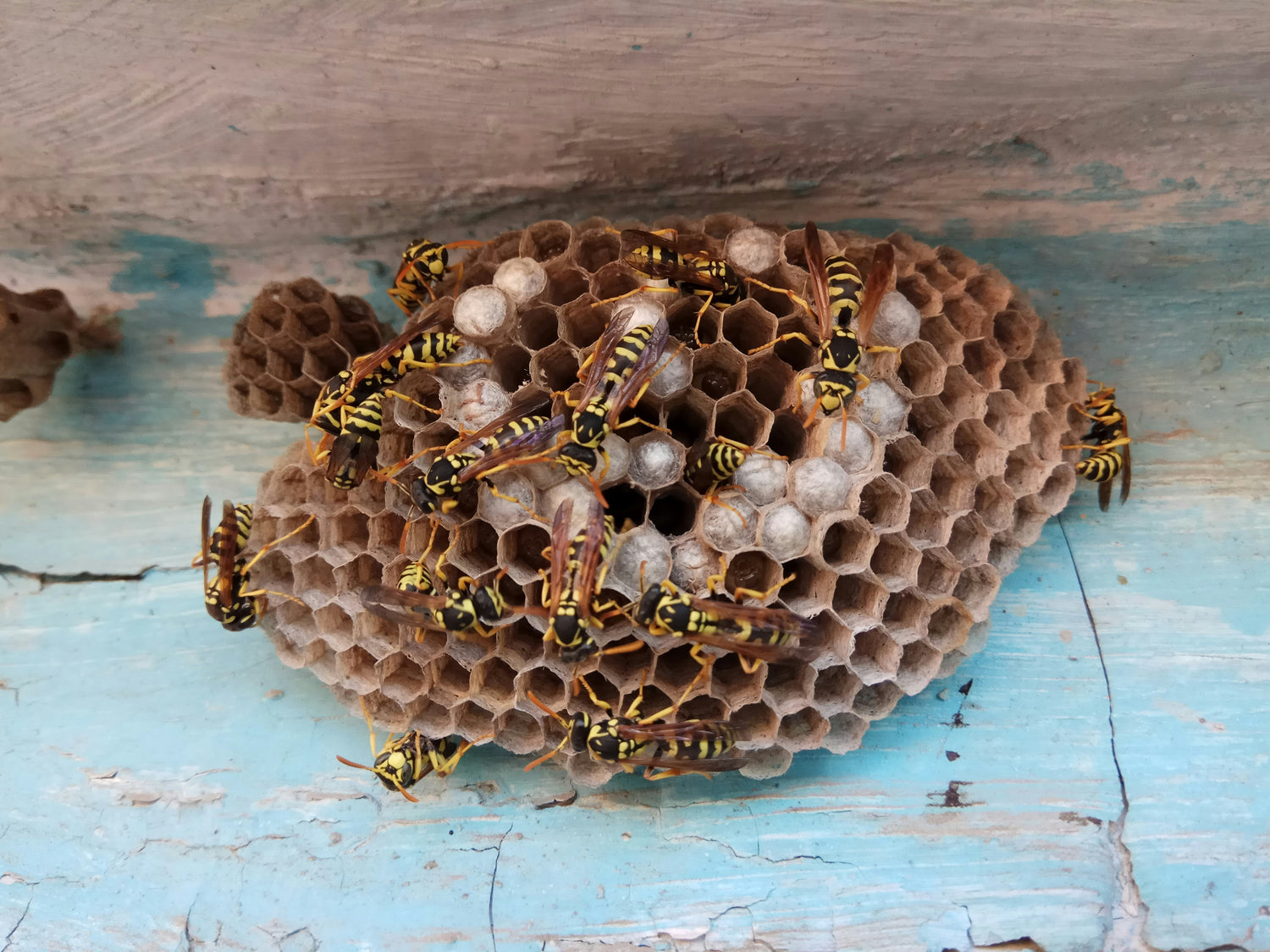
Wasp nests are annual. Every spring a fertilized queen begins entirely alone to build a small nest — often no larger than an apple — and lays the first eggs. During early summer the first workers take over the nest building and the queen devotes herself to laying eggs.
During peak season in July–August a large nest can contain 5,000 to 10,000 individuals. In September the colony begins to die out: the queen leaves the nest, the workers die, and the newly fertilized queens overwinter in sheltered positions — under bark, in soil crevices, or in the house foundation. The nest is never used again, but the location may be chosen anew by a new queen the following spring.
Common wasp species in Europe
Across Europe there are numerous wasp species, but the vast majority we encounter near houses belong to just a few:
- Common wasp (Vespula vulgaris) — the most prevalent across Europe. Yellow and black striped, 12–17 mm. Builds nests in the ground, in walls, and under eaves.
- German wasp (Vespula germanica) — very similar to the common wasp but with three dots on the face rather than one. Equally widespread and equally aggressive when disturbed.
- European hornet (Vespa crabro) — Europe's largest native wasp, up to 35 mm. Reddish-brown and yellow. Less commonly encountered but impressively large. Not more aggressive than the common wasp if the nest is left undisturbed.
- Asian hornet (Vespa velutina) — an invasive species spreading across parts of western and southern Europe. Darker in color with a yellow-tipped abdomen. A concern primarily due to its impact on honeybee populations.
Bees are often confused with wasps but are hairier, rounder, and rarely aggressive. Bees sting only once (they die afterward). Wasps can sting repeatedly.
Where do wasps build nests?
The wasp queen chooses locations that are sheltered, dry, and relatively hard to access. The most common locations in and around the house are:
- The eaves and under the outer roof — a popular spot thanks to the protection from rain
- Cavities in walls and facade — cracks, gaps, and unsealed holes
- Storage rooms and garages — dark, quiet spaces with access to wood material
- Under the terrace or deck floor — sheltered and undisturbed
- In the ground — many species build ground nests, often hidden under a stump or root cluster
Nests inside walls or structures are the most difficult situation — the wasps can build large nests without being visible, and vibrations or disturbances can trigger an aggressive defense.
Wasp stings — risks and what to do
Most wasp stings produce local symptoms: pain, redness, and swelling that subsides within a day. Treat with cold and take an antihistamine if needed to reduce itching and swelling.
The real risk is an allergic reaction. Approximately 1–3 percent of the population is allergic to insect venom to the degree that a sting can trigger anaphylaxis — a life-threatening systemic reaction with breathing difficulties and a drop in blood pressure. Signs of a serious reaction: itching and rashes far from the sting site, swelling of the face and throat, dizziness, or shortness of breath.
If you have been diagnosed with a wasp allergy you should always carry an EpiPen and seek emergency care when stung. Call your local emergancy number immediately if you or someone nearby shows signs of anaphylaxis.
What you should NOT do when dealing with a wasp nest
The most common mistake is trying to block the entry hole of an active nest — this traps the wasps inside and makes them extremely aggressive. Other things to avoid:
- Hitting the nest or shaking it — wasps perceive vibrations as an attack
- Pouring water or petrol into the nest — ineffective and dangerous
- Spraying with household insecticide — the reach is too short and triggers an attack
- Trying to remove a large nest (bigger than a tennis ball) without protective equipment
Empty nests in autumn and winter are completely harmless and can be removed by hand. There is never any urgency if the nest is not disturbing you.
How to remove a wasp nest
Small nests early in the season (May–June), with visible comb structure and a maximum of 20–30 wasps, can be handled on your own in the evening when the wasps are passive — with the right protective equipment and insecticide directed into the nest opening.
Large nests, nests inside walls, and nests near allergy sufferers or children are tasks for a pest control company. They use professionally approved insecticide with sufficient reach and can ensure that the entire colony is targeted.
Wasps in autumn — why they become more aggressive
In late summer and early autumn the behavior of wasps changes markedly. The colony is in the process of dying out, there is no longer any brood to protect, and the wasps are desperately seeking sugar to survive. This is why they swarm around sweet drinks, fruits, and barbecue food — and are more prone to stinging when disturbed.
Advice during peak season: cover sweet drinks, bring in ripe fallen fruit, avoid swatting at wasps, and do not wear strongly scented perfume outdoors.
Prevent wasps from building a nest near the house
The best thing you can do is inspect the house early in spring — in April–May — and seal holes and gaps in the eaves, facade, and foundation before the queens start looking for nesting sites. Old nests should be removed (they are not reused, but the location may be chosen again by a new queen).
Also remove things that attract wasps: open rubbish bins, ripe fallen fruit, and access to sweet drinks on the patio.