
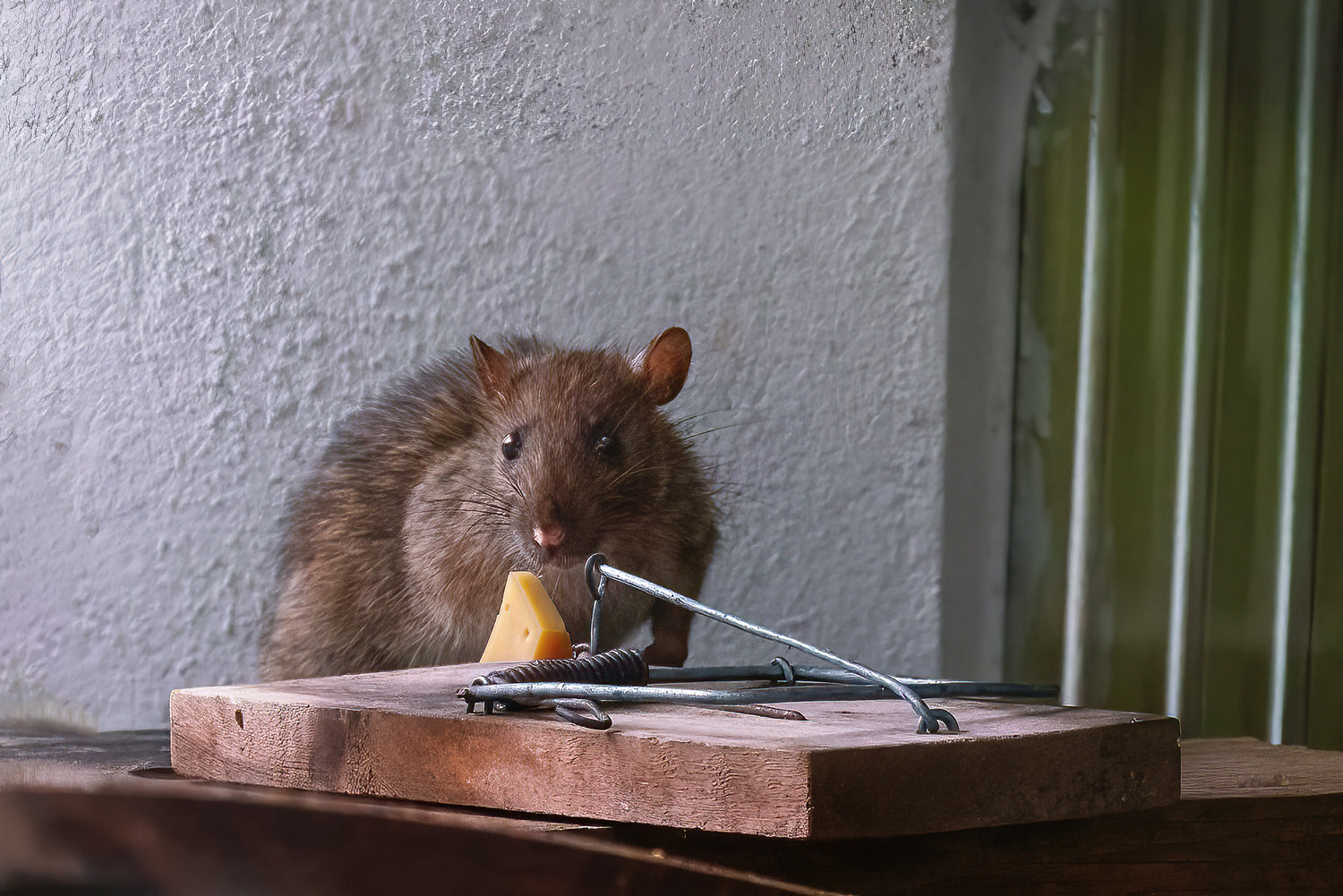
Rats in the house are a problem you want to catch early. The faster you act, the easier it is to get on top of the problem — and the less damage the rats will have time to cause. The difficulty is that rats are shy animals that rarely show themselves openly. Instead, they leave traces.
In this guide we go through the 10 clearest signs that you have rats in your home, what to look for and where to look. You do not need to see a rat with your own eyes to be certain — the traces are enough.
The most common signs:
- Droppings in hidden spaces
- Gnaw marks on food, packaging, or structures
- Scratching or scurrying sounds — particularly at night
- Grease stains or dirty tracks along walls and floors
- Nests made of shredded materials in dark corners
- Chewed cables, pipes, or insulation
- Footprints or tail tracks in dust
- A strong, distinct smell of urine
- Disturbed or gnawed food packaging
- Your pet behaving strangely near a specific spot
1. Droppings — the most common sign
Rat droppings are often the first sign people find. A rat produces up to 40 droppings per day, so they accumulate quickly. The droppings are 1–2 centimetres long, dark brown to black, and tapered at the ends — somewhat like an olive stone.
Typical places to find droppings: behind white goods, inside cupboards, along walls in the basement, under the kitchen sink, and in storage spaces. Fresh droppings are soft and glossy. Old droppings are dry and grey. If you find both fresh and old droppings, the rats are still active.
Note: always wear gloves when handling droppings. Rats can carry infectious agents that are spread through faeces.
2. Gnaw marks — rats must gnaw constantly
Rats' front teeth grow throughout their entire lives. To keep them worn down, rats gnaw on almost anything — wood, plastic, concrete, cables, and food packaging. Gnaw marks appear as uneven, hollowed-out, or broken surfaces.
Pay particular attention to corners and edges of wooden beams, boxes in the storage room, and packaging in the pantry. Chewed electrical cables are a serious sign — it means both that rats are present in the house and that there is a fire risk.
3. Sounds — scratching, scurrying, and squeaking
Rats are nocturnal and move around most when the house is quiet. The most common sounds are scratching and scurrying footsteps — often in walls, under the floor, or in the ceiling. Sometimes squeaking sounds can also be heard, which may indicate that there are young present.
If you hear sounds in the walls late in the evening or early in the morning, it is worth investigating further. Rats are heavy enough to be heard clearly when they move around indoors.

4. Grease stains and dirty tracks along walls
Rats have poor eyesight and always follow the same paths along walls and obstacles. Over time, their fur and skin leave grease deposits and dirt along these routes — often at a height of 5–10 centimetres from the floor.
Do you see dark, greasy marks along a wall in the basement, behind the refrigerator, or along a skirting board in the storage room? That is a classic rat run. These paths are known in English as "runways" and show exactly which routes the rats are using.
5. Nests made of shredded materials
Rats build nests in dark, sheltered spaces using materials they find nearby — newspaper, fabric, insulation, packaging material, and similar items. If you find a pile of shredded, gathered materials in a corner of the basement, behind a boiler, or in a storage space, it is most likely a rat nest.
Nests often contain droppings and have a distinct smell. If the nest feels warm to the touch, the rat may still be using it.
6. Chewed cables and pipes — a warning signal
Chewed electrical cables are one of the most serious signs of a rat invasion. Rats cause a number of fires in Sweden every year due to gnawed wiring. If you find damaged cable insulation, you should contact an electrician and at the same time begin taking measures against the rats.
Also look at water pipes and insulation in crawl spaces or attics — gnaw damage there can lead to leaks and mould.
7. Paw prints and tail marks in dust or mud
In dusty spaces, such as basement floors, attics, or outside the house in mud, rats can leave clear paw prints and tail marks. A rat's front paw has four toes, the back paw five. The tail often leaves a narrow line between the paw prints.
Try sprinkling a little flour or talcum powder along a suspected run and check the next morning — if there are paw prints, you have confirmed activity.
8. Strong smell of urine
Rat urine has a sharp, ammonia-like smell that is hard to mistake — particularly in enclosed spaces such as cupboards, basements, or storage areas. Rats urinate along their runs as a way of marking territory.
If you notice a distinct, unpleasant smell that you cannot explain, especially in combination with other signs on this list, rats are a likely explanation.
9. Disturbed or gnawed food packaging
Rats actively search for food and can get into food packaging made of paper, plastic, and thin metal. If you find holes in cereal packaging, gnawed corners on cardboard boxes, or spilled food without any visible explanation — investigate carefully.
Food that rats have eaten from should be thrown away. It is better to store dry goods in airtight containers made of glass or hard plastic.
10. Pets behaving strangely
Dogs and cats have a significantly sharper sense of smell and hearing than humans. If your pet suddenly sniffs intensely along a wall, scratches at a specific hatch, or stares persistently into a corner — take it as a signal worth investigating.
Pets often react to rats long before the owner notices anything. It is not uncommon for dogs or cats to "find" the problem in the basement or behind a panel weeks before other signs appear.
What do you do if you find these signs?
If you find one or more of the signs above, you should act quickly. Rats reproduce rapidly — a pair can become an entire colony in just a few months. The first step is to find out how the rats are getting in and what is attracting them.
There are several measures you can take on your own and methods to prevent future problems. Repello's technology is based on keeping rats away without traps or poison — a preventative alternative that suits many homes and properties.